
|
RNA Amplification
Frequently Asked Questions
SenseAMP and SenseAMP Plus Questions
|
| |
|
| |
What is the difference between the SenseAMP and SenseAMP Plus kits? |
| |
Both kits provide materials needed to amplify any RNA sample. SenseAMP Plus contains four additional reagents (vials) for an additional enzymatic reaction that ensures the addition of poly(A) tails to the 3' ends of all amplified products. Both kits produce sense-strand amplified RNA (senseRNA) that is much more representative of the original unamplified sample than is conventional antisense RNA. Both kits successfully amplify degraded and prokaryotic RNA, including RNA extracted from paraffin-embedded samples. The choice of kit would be determined by what you want to do with the senseRNA. If you would like to use the senseRNA in a reaction that uses random primers, the SenseAMP product is needed. If you would like to use the senseRNA in a reaction that uses dT primers, the SenseAMP Plus product is needed. |
| |
|
| |
What are the most critical points in the procedure? |
| |
| 1. |
cDNA synthesis: confirm that the RT enzyme is working appropriately (do not use an expired RT enzyme) and that cDNA is made. |
| 2. |
Qiagen PCR MinElute purification: Follow the protocol in the SenseAMP Procedure; not Qiagen’s procedure. |
| 3. |
TdT Tailing: Do not exceed 3 minutes. |
| 4. |
T7 Promoter synthesis: Do not make a master mix of 10X buffer, dTNPs, and Klenow. Add these components separately, and in the order listed in the protocol. |
| 5. |
In Vitro Transcription: Thoroughly thaw and vortex the reaction buffer. Ensure that both the 10X T7 reaction buffer and ribonucleotides have thawed to room temperature. Do not make a master mix of ribonucleotides, 10X T7 reaction buffer, and T7 enzyme mix. Add these components separately, and in the order listed in the protocol. |
|
| |
 |
| |
What is the typical fold-amplification? |
| |
The fold-amplification will vary depending on factors like the species and quality of RNA, as well as the primer selected for cDNA synthesis. Generally, the mRNA will be amplified between 500-fold and 1000-fold. When the senseRNA is quantitated, it is important to calculate the fold-amplification based on the following factors:
| |
 |
How much of the total RNA is mRNA? |
| |
|
Which primers were used for cDNA synthesis? |
| |
|
Was half, or all, of the T7 promoter-modified cDNA used in the IVT reaction? |
Example 1, use of dT primer:
Start with 1ug of total RNA
Assume 3% of the total RNA is mRNA
Use dT primer for cDNA synthesis
Use half of the T7 promoter-modified cDNA in the IVT reaction
7.5-15µg senseRNA should be recovered
Example 2, use of random or random/dT primers:
Start with 1ug of total RNA
Assume 3% of the total RNA is mRNA
Use either random primers or both random and dT primers for cDNA synthesis
Use half of the T7 promoter-modified cDNA in the IVT reaction
37.5-75µg of amplified RNA should be recovered
Estimate that 20% of this is true senseRNA (the rest may be amplified ribosomal RNA)
|
| |
|
| |
Are there any consequences to using random primers with total RNA in the SenseAMP procedure?
|
| |
Ribosomal RNA will be amplified when random primers are used. However, provided that the appropriate stringency is maintained, the amplified ribosomal RNA will not bind to a microarray (even if it is labeled). Simply use more senseRNA into the labeling reaction for later hybridization to microarrays. More senseRNA is needed for the labeling reaction to accommodate the portion of senseRNA that is actually the amplified message. |
| |
|
| |
Why do I have to label so much senseRNA for microarray hybridization? |
| |
In most RNA amplification methods, considerable quantities of amplified RNA are labeled for hybridization to microarrays. For example, Affymetrix requires 10µg of cRNA for hybridization to one GeneChip. Genisphere has compared sensitivity on microarrays using both amplified and unamplified RNA. Based on these experiments, we have made recommendations in our protocols for how much senseRNA to use in your labeling reactions. |
| |
|
| |
Does Genisphere have a special amplification protocol for LMW RNA samples? |
| |
Yes. If you would like to use the SenseAMP Plus kit to amplify LMW RNA samples, download the protocol from our website. |
| |
|
| |
How degraded can an RNA sample be before amplification with SenseAMP?
|
| |
If you have a partially degraded RNA sample, use one of the following methods to determine the integrity of the sample.
| |
|
Arcturus Paradise QC Process (Beta-Actin 3’/5’ value): the QC Metric value should be between 1 and 164 (see application note for the amplification of FFPE RNA samples). |
| |
|
Agilent Bioanalyzer: the subunit ratio should be between 1.0 and 2.4. |
| |
|
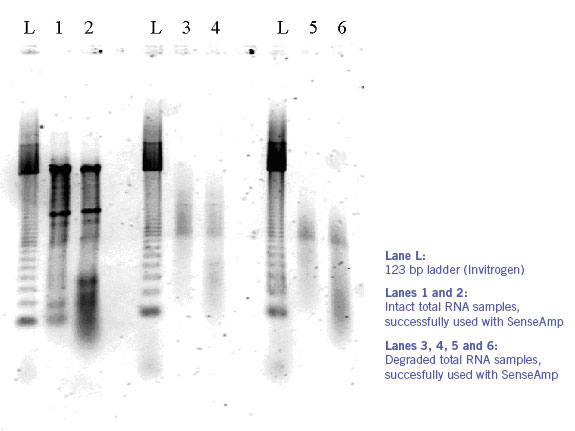
Gel electrophoresis: some visible smear of RNA should be observed, between 0.1-2Kb in length. The ribosomal RNA subunits should appear intact. Run an intact RNA sample on the same gel for comparison purposes (see Figure 1). |
Figure 1: 1% agarose gel of intact and degraded RNA samples. One microgram of each RNA sample was loaded onto the gel.
 |
| |
|
RampUP and RampUP Plus Questions
|
|
| |
|
| |
What is the difference between RampUP and SenseAMP kits? |
| |
SenseAMP is designed for one round of amplification and can accommodate as little as 25ng of total RNA for amplification. RampUP is designed for two rounds and can accommodate less than 25ng of total RNA. Both kits will generate sense-strand copies of the original sample and will amplify both intact and partially degraded RNA. |
| |
|
| |
What is the difference between the RampUP and RampUP Plus kits? |
| |
Both kits provide materials needed to amplify any intact or degraded RNA sample and generate sense-strand copies of the original RNA. RampUP Plus is unique in that it provides additional reagents needed to synthesize a poly(A) tail on the 3’ end of the amplified product. Therefore, the choice of kit is determined by whether or not a poly(A) tail is required for downstream analysis. If the downstream analysis utilizes random primers for reverse transcription, a poly(A) tail is not required and the RampUP kit will be sufficient. If, however, the application utilizes a dT primer for reverse transcription, the RampUP Plus kit is needed to generate a poly(A) tail. |
| |
|
| |
|
| |
What is the minimum starting amount of total RNA that can be used in the RampUP protocol? |
| |
Best results can be obtained when using at least 1ng, however, as little as 10pg has been used successfully. The amplification yield of RampUP will vary from sample to sample due to differences in mRNA content and quality. For example, 20ng of a very intact RNA sample (Mouse Brain Total RNA, Ambion cat. no. AM7812) may yield 100µg of senseRNA, whereas 20ng of an FFPE sample may yield 20µg senseRNA or more. Therefore, Genisphere recommends using 1-25ng of intact RNA or 20-25ng of FFPE RNA with RampUP. |
| |
|
| |
Is RampUP compatible with Affymetrix GeneChips? |
| |
Yes. For Affymetrix 3’ arrays, an additional labeling kit is needed: the cDNA Synthesis Kit, catalog number CNDAMOD. For Affymetrix exon arrays, please contact Genisphere Technical Support. |
| |
|
| |
Can RampUP amplify partially degraded LCM and/or FFPE samples? |
| |
Yes. Both RampUP and SenseAMP have been shown to be the preferred method for amplifying compromised samples such as those derived from LCM and FFPE. |
| |
|
| |
The RampUP protocol calls for RNA in a volume of 2µL. If an RNA sample is in a volume of more than 2µL, can it be concentrated? |
| |
Yes, provided the RNA is suspended in water. If so, follow any of the below procedures to concentrate the RNA sample:
-SpeedVac or similar vacuum concentrator
-Lyophilization
-Evaporation in a 60°C heat block
-Microcon® YM-3 concentrator (Millipore™ cat. no. 42404) |
| |
|
| |
|
| |
How degraded can an RNA sample be before amplification with RampUP? |
| |
If feasible, check the integrity of each RNA sample prior to amplification. If the RNA is intact, Random Primer (Vial 2) may be omitted from the first reverse transcription step (see protocol). If the RNA is partially degraded, use both random and dT primers in the first reverse transcription step (see protocol). The RampUP kits will amplify partially degraded RNA samples, but cannot amplify completely degraded RNA samples. One of the following methods should be used to determine the integrity of the sample:
- Arcturus Paradise™ QC Process (Beta-Actin 3’/5’ value). Intact RNA samples have a QC Metric value between 1 and 10. Partially degraded RNA samples have a QC Metric value between 11 and 164.
- Quantitation of ribosomal subunits. Intact RNA samples have a subunit ratio between 1.5 and 2.4. Partially degraded RNA samples have a subunit ratio less than 1.5.
- Gel electrophoresis. Intact RNA samples have two sharp, bright bands of rRNA. Partially degraded RNA samples have some visible smear of RNA, between 0.1-2Kb in length. See Figure 1 for examples of both intact and partially degraded RNA samples.

|
| |
|
| |
Does the RampUP procedure amplify ribosomal RNA and if so, what are the consequences? |
| |
Yes, ribosomal RNA will be amplified by the RampUP process, however, the consequences are negligible when dealt with properly. For microarray analysis, it is critical to maintain appropriate stringency to minimize the impact of ribosomal RNA to the array data. In addition, the presence of ribosomal RNA in the amplified product will require an increase in the amount of senseRNA for downstream analysis (typically by a factor of about five over amplification products generated with a dT primer alone). |
| |
|
| |
|
| |
How long are senseRNA products generated by RampUP? |
| |
Since random primers are used in both the first and second round of the RampUP process, senseRNA resulting from amplification of intact RNA samples range in size from 50 to 500 bases in length. The size of amplification products from degraded RNA will be shorter, depending on the level of degradation

|
| |
|
| |
What are the most critical points in the procedure |
| |
a. cDNA synthesis: Confirm that the RT enzyme is working appropriately (do not use an expired RT enzyme) and use fresh T4gp32 (round 1 only).
b. Purifications: Be sure to follow the procedures for purifications as outlined in the protocol as opposed to the procedures provided by the manufacturer. These steps have been adjusted for optimal performance with RampUP.
c. TdT Tailing (round 1): Do not exceed 2 minutes.
d. T7/T3 Promoter synthesis (round 1): Do not make a master mix of 10X buffer, dTNPs, and Klenow. Add these components separately, and in the order listed in the protocol.
e. In Vitro Transcription (rounds 1 and 2): Thoroughly thaw and vortex the reaction buffer. Ensure that both the 10X IVT reaction buffer and ribonucleotides have thawed to room temperature. Do not make a master mix of ribonucleotides, 10X T7 reaction buffer, and T7 enzyme mix. Add these components separately, and in the order listed in the protocol. |
| |
|
| |
Why is T4gp32 used in the reverse transcription reaction? |
| |
T4gp32 is a DNA binding protein that is added to the reverse transcription reaction to increase the efficiency of cDNA synthesis of small amounts of RNA. Since this is a key component in the reverse transcription of RNA samples in the 10pg to 10ng range, it is required in the initial reverse transcription step of the RampUP protocol. |
| |
|
| |
The RNeasy MinElute columns are designed to purify RNA. Why are these columns used to purify cDNA after the initial reverse transcription reaction in the RampUP procedure? |
| |
A thorough in-house study of cDNA purification, using a variety of methods, has shown that RNeasy MinElute columns are the most effective at purifying cDNA by removing primers and other potential contaminating agents without sacrificing cDNA yield. For best results, be sure to follow the RNeasy MinElute procedure outlined in the RampUP protocol. |
| |
|
| |
In Round 1 of RampUP, why is only half of the T7/T3-modified cDNA used in the IVT reaction? |
| |
Using half of the T7/T3-modified cDNA in the IVT reaction helps to keep non-specific amplification products low, while allowing high yield amplification after two rounds. It also eliminates the need to purify the cDNA prior to the first IVT reaction. |
| |
|
| |
Are there any restrictions for labeling senseRNA for microarray analysis? |
| |
No. SenseRNA generated by RampUP and RampUP Plus can be labeled by any standard method. If using the following Genisphere labeling kits; Array 50, Array 350 of Array 900, for senseRNA generated from RampUP Plus, you may need to purchase additional primer for reverse transcription. Please use the following catalog numbers when ordering:
1. cat. no. CMR960UA (Primer-30 pmol-Cy3, Alexa 546, Oyster 550)
2. cat. no. CMR960UB (Primer-30 pmol-Cy5, Alexa 647, Oyster 650) |
|


