| |
Appendix C
Hybridization Volume/Cover Slip Table and Microarray Loading Technique |
|
| |
Appendix C. Hybridization Volume/Cover Slip Table and Microarray Loading Technique
|
| The following table should be used as a guide for determining the appropriate hybridization volume for standard, flat coverslips. Note that Enhanced Hybridization Buffer (for use only in the cDNA hybridization) requires higher volumes as a result of the increased viscosity of this buffer. |
| |
| Suggested Hybridization Volumes for Various Flat, Glass Coverslips |
| |
Coverslip Size (mm)
|
22x22
|
24x30
|
24x40
|
24x50
|
24x60 |
| Vial 6 and Vial 7, approximate hybridization volume (ul) |
17 |
25 |
33 |
42 |
50 |
| Enhanced Hybridization Buffer, approximate hybridization volume (ul) |
20 |
29 |
38 |
48 |
58 |
|
| |
 |
|
| Microarray Loading Technique |
|
|
| 1. |
Make up appropriate volume for size coverslip (see table above). |
| 2. |
Prewarm array, hybridization mix, and chamber to hybridization temperature (see protocol). |
| 3. |
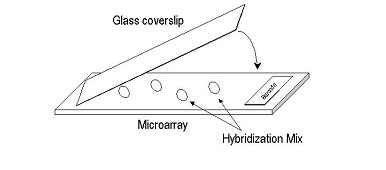
Pipet hybridization mix across array surface. Avoid drawing air into pipet tip and any contact with array surface. |
| 4. |
Placing one end of a clean coverslip onto the array, SLOWLY lower the other end of the coverslip. If done properly, the hybridization mix should form a bubble-free interface between the coverslip and the array as the coverslip is lowered. |
| |
|
| |
 |
| |
 |
|
|


