|
|||||||||||||||||
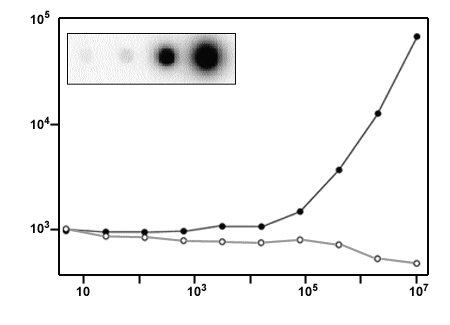
The Use of 3DNA Dendrimer Technology to Quantitate Viral Load in Post-Transplant Lymphoma PatientsSummary  Measurement of viral load in patient samples is a pressing problem for many clinical research programs. The key technical goals are: (1) adequate levels of detection sensitivity, (2) high test-to-test reproducibility, and (3) a simple and efficient assay protocol. The experiments presented in this report deal with the detection of Epstein-Barr virus transcripts in both cultured cells and patient samples. The results clearly show that 3DNA hybridization probes can be valuable tools for clinical analysis because of their inherent detection sensitivity and reliability. "These combined results suggest strongly that 3DNA dendrimer hybridization is a methodology of substantial value in clinical analysis and that it offers for many nucleic acid based assays a simple, fast and reproducible method of quantitative detection." Introduction Epstein-Barr Virus (HHV-4) is a ubiquitous human herpes virus and is the representative member of the lymphocryptovirus family (Krief, 1996). Primary infection by EBV is controlled by the cellular immune response, and thereafter EBV can only be found as a latent infection of B lymphocytes. The primary clinical interest in EBV stems from its association with a number of human malignancies including Burkitt's lymphoma, certain types of Hodgkin's disease, naso-pharyngeal carcinoma, AIDS-lymphoma and post-transplant lymphoproliferative disease (PTLD). In each of these malignancies EBV is found in the latent state. Three types of EBV latency, based on characteristic patterns of viral gene expression, have been described. In the most active of these, Type III latency, all of the viral latency proteins are expressed and, in addition, the virus expresses two abundant non-translated RNA polymerase III transcripts known as EBER-1 and EBER-2. Each of these transcripts is present at an estimated 1-10 million copies per cell. EBER-1 and EBER-2 are 166 and 172 bases in length, respectively, exhibit complex secondary structure due to extensive inter-molecular base-pairing and are associated with ribonuclear protein complexes. Great strides have been made in treating PTLD in the bone marrow transplant setting using adoptive immunotherapy with EBV specific T-cell lines. The key question in the immunotherapy of PTLD is when to infuse the therapeutic cells. Published studies have indicated that a sharp increase in EBV load in the peripheral blood correlates with the onset of malignancy in both bone marrow and solid-organ transplantation. These studies are most often carried out by PCR amplification of viral DNA. In this report we examine a new approach to the determination of viral load in peripheral blood using DNA dendrimer technology (3DNA, Genisphere Inc). DNA dendrimers are highly-branched, multi-layered structures that act as scaffolds for the attachment of specificity-determining oligonucleotides and of label. It is the multiplication of binding sites for labeled oligonucleotides which gives the high degree of signal amplification. Using 3DNA dendrimers, we found that we were clearly able to detect the increased EBV load seen in two patients with PTLD. Materials and Methods EBV RNA was isolated either from banded PBMC or cultured B95.8 cells with TRIzol (Gibco-BRL) and precipitated. Pellets were resuspended in sterile RNAse-free water. Analysis of the RNA was done by dot blot (Bio-Dot apparatus, Bio-Rad) on positively charged nylon membrane according to standard procedures. DNA samples were prepared for dot-blotting by pretreatment with NaOH. Three 3DNA dendrimer structures specific for different regions of the EBER-1 sequence were prepared by attaching the EBER Dendrimers to radiolabeled oligonucleotides complementary to one of the terminal arms of the dendritic structure (Nilsen, et al., 1997). Labeling was done using a primer extension reaction with Klenow DNA Polymerase I. Reaction products were purified by size exclusion chromatography. The labeled 3DNA dendrimer probes were hybridized to the RNA or DNA dot-blots under standard stringency conditions, washed and imaged electronically using a Packard Instant Imager. Results Our laboratory has a pressing need to measure EBV load quickly and reproducibly. To this end, we have developed a rapid technique which takes advantage of the high number of EBER RNA molecules expressed in each latently infected call and which avoids the need for enzymatic amplification from clinical material. Signal amplification was achieved using dendritic DNA structures constructed to anneal to EBER RNA in a sequence-specific manner (Nilsen, el al., 1997; Vogelbacker, et al. 1997). In order to estimate the limit of sensitivity for the detection of membrane-bound EBER-1 sequences, DNA from an EBER-containing plasmid was used as a quantifiable target. Figure 1 shows that increasing numbers of EBER targets give an increasing hybridization signal. The slope of the curve (less background) indicates that the 3DNA dendrimer can detect a minimum of 37,000 sequences in a membrane assay.
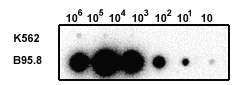
The ability of EBER-specific dendrimers to detect EBER RNA from infected cells was tested using the EBV-transformed cell line B95.8 (Miller and Lipman, 1973). When B95.8 cells were subjected to limiting dilution and total RNA was isolated from each dilution, as few as 10 cells could be detected with the EBER-specific 3DNA probes (Figure 2).
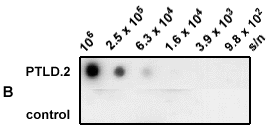
Previous studies in our laboratory demonstrated that a four-fold dilution series of clinical samples gives an informational range of EBV signal within a reasonable number of dilutions. Using this four-fold dilution method, peripheral blood mononuclear cells (PBMC) from two patients with PTLD were analyzed for EBV load by 3DNA dendrimer hybridization. In both cases, positive signals were seen (Figure 3 A,B). Upon resolution of their symptoms, the viral load returned to undetectable levels. Thus, we have shown that membrane hybridization with 3DNA dendrimers is sensitive enough to detect EBV reliably in PTLD clinical samples.
Discussion 3DNA dendrimer hybridization represents a valuable technology which greatly enhances the level of sensitivity of DNA and RNA blotting techniques. In the application of 3DNA technology to the analysis of clinical samples the primary goal is to provide a rapid methodology which will give consistent and reliable results. Studies with 3DNA dendrimers using other targets have demonstrated a 500-1000 fold signal enhancement over direct blotting and the level of reproducibility expected when using a defined chemical product. Our report here demonstrates that use of 3DNA dendrimers is a very efficient means to detect low levels of target nucleic acid bound to membrane, as evidenced by the detection limit of approximately 37,000 EBER-1 copies in plasmid DNA. When total RNA was extracted from the B95.8 cell line, a level of sensitivity of ten B95.8 cells was reached. When clinical PTLD specimens were analyzed for EBV load, DNA dendrimers were able to detect the presence of EBER sequences. These combined results suggest strongly that 3DNA dendrimer hybridization is a methodology of substantial value in clinical analysis and that it offers for many nucleic acid based assays a simple, fast and reproducible method of quantitative detection. |
|||||||||||||||||
  14 Philips Parkway Montvale, NJ 07645 Phone: 877.888.3DNA or 201.651.3100 Fax: 877.FAX.3DNA or 201.651.3116 E-Mail: [email protected] Copyright © 1998-2000 Genisphere. All rights reserved. |
|||||||||||||||||